
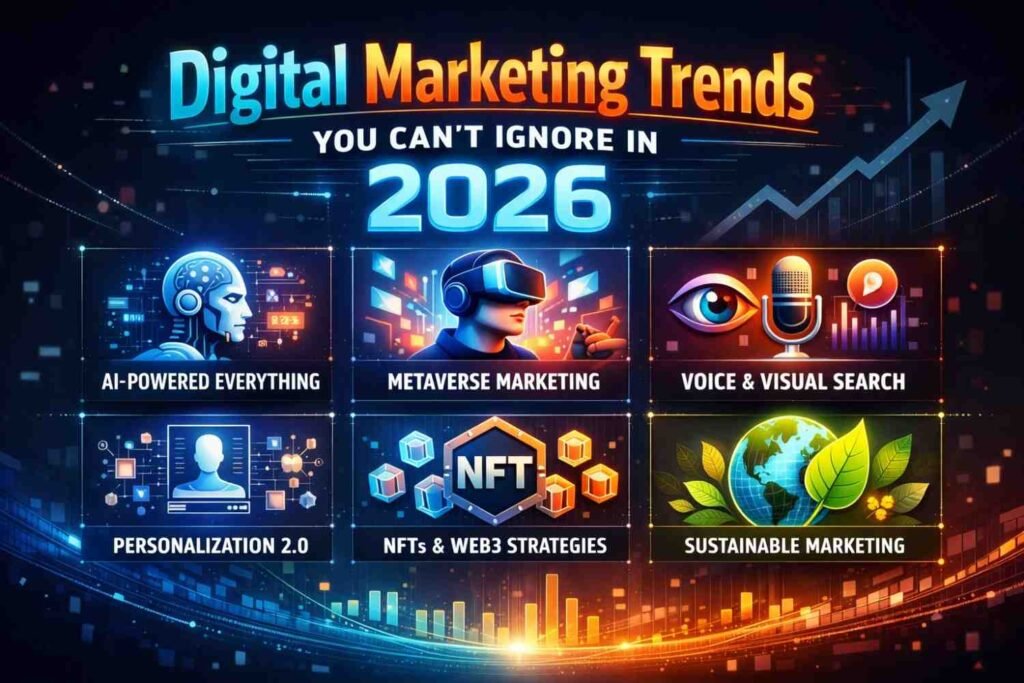
Digital marketing trends are changing rapidly as technology, consumer behavior, and search engines continue to evolve. With rapid advancements in artificial intelligence, shifting consumer behavior, and stricter data privacy rules, businesses must adapt to stay competitive. As we step into 2026, every digital marketer who follows the latest trends will have a clear advantage over those who don’t.
Here are the most important digital marketing trends you can’t ignore in 2026.
1. Artificial Intelligence (AI) in Marketing Becomes Mainstream
Artificial Intelligence is no longer an advanced option—it has become a core part of modern digital marketing. In 2026, businesses of all sizes rely on AI to improve efficiency, accuracy, and customer experience, making it one of the most impactful digital marketing trends shaping the industry. AI helps marketers analyze large amounts of data in seconds, something that would take humans days or weeks.
AI-powered tools are widely used for content generation, predictive analytics, customer segmentation, ad optimization, and real-time decision-making. From writing ad copies to optimizing email subject lines, AI reduces manual work and improves results.
Key benefits of AI in marketing include:
- Faster analysis of customer behavior and trends
- Personalized content and ad recommendations
- Automated email campaigns and chatbots
- Better forecasting of customer needs and buying patterns
Marketers who learn how to use AI tools effectively will work smarter, save time, and deliver better marketing results.
2. Hyper-Personalization Is the New Standard
Customers expect personalized experiences, not generic ads. In 2026, brands focus on hyper-personalization, using data to deliver the right message at the right time.
Examples include:
- Personalized email campaigns
- Product recommendations based on behavior
- Customized landing pages
Personalization improves engagement, trust, and conversion rates.
3. Voice Search & Conversational SEO Growth
With the increasing use of smart devices and voice assistants, voice search has become a major part of online searches, making it one of the important digital marketing trends influencing how users find information online. People now search differently—they speak in full sentences instead of typing short keywords.
This shift has changed SEO strategies. In 2026, marketers focus on conversational SEO, which means optimizing content to match natural language and spoken queries.
Key optimization strategies include:
- Using long-tail and question-based keywords
- Writing content that directly answers user questions
- Improving local SEO for “near me” searches
- Creating FAQ-style content
Websites that provide clear, direct, and helpful answers are more likely to appear in voice search results and featured snippets.
4. Short-Form Video Dominates Social Media
Short videos continue to rule platforms like Instagram Reels, YouTube Shorts, and TikTok. In 2026, video is the most engaging content format.
Why short videos work:
- High engagement rates
- Easy to consume
- Strong brand recall
Brands that invest in consistent video marketing will see better reach and visibility.
5. Cookieless Marketing Shapes Future Digital Marketing Trends
With third-party cookies disappearing, marketers shift toward first-party data strategies.
Key changes include:
- Email marketing growth
- CRM-based marketing
- Consent-based data collection
Transparency and user trust become more important than aggressive tracking.
6. Influencer Marketing Becomes More Authentic
Influencer marketing continues to grow, but authenticity matters more than popularity in 2026. Audiences trust real experiences over polished promotions, which is why micro-influencers often outperform celebrities.
Brands now focus on meaningful collaborations rather than one-time sponsored posts.
Key influencer marketing trends include:
- Long-term partnerships with creators
- Targeting niche and local audiences
- Honest reviews and storytelling
When influencers genuinely believe in a product, their content feels natural and trustworthy—leading to better engagement and conversions.
7. Search Engines Focus on Helpful Content
Search engines prioritize experience-based, helpful, and human-written content. Keyword stuffing no longer works.
Successful content in 2026:
- Solves real user problems
- Shows expertise and experience
- Is easy to read and well-structured
Quality content always wins.
Conclusion
Digital marketing in 2026 is smarter, more personal, and more user-focused than ever before. AI, video content, voice search, and data privacy are shaping the future. Businesses and marketers who adapt early will stay ahead of the competition.