
Introduction
Getting visitors to your website is one of the biggest challenges for any business. Even if you have a well-designed website with quality products or services, it won’t deliver results unless people can find it. Website traffic is important because it creates opportunities to generate leads, increase sales, build brand awareness, and grow your online presence.
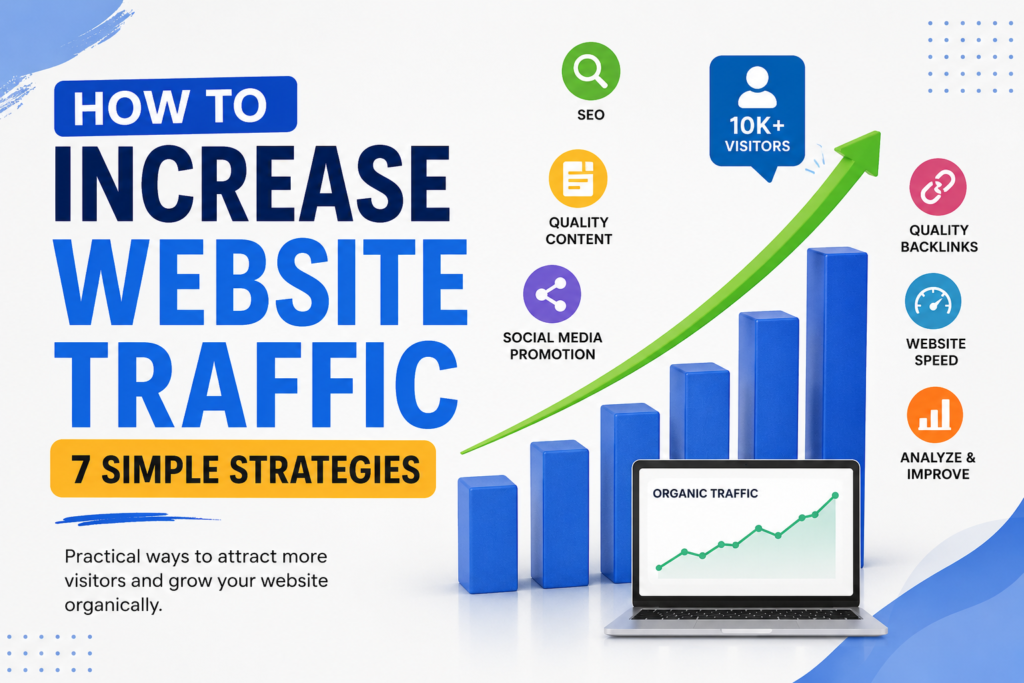
The good news is that increasing website traffic doesn’t always require a large advertising budget. By combining search engine optimization, valuable content, social media marketing, and other digital marketing strategies, businesses can consistently attract more visitors. In this guide, you’ll learn seven simple strategies that can help increase website traffic and improve your online visibility.
1. Optimize Your Website for SEO
Search Engine Optimization (SEO) is one of the most effective ways to increase website traffic. SEO helps search engines understand your website and improves its chances of appearing in organic search results.
Focus on creating SEO-friendly content, using relevant keywords naturally, improving page titles and meta descriptions, optimizing images, and maintaining a clear website structure. A well-optimized website has a better chance of attracting consistent organic traffic over time.
2. Create High-Quality Content
Content remains one of the strongest drivers of website traffic. Publishing useful blog posts, guides, tutorials, and industry insights helps answer users’ questions while improving your website’s visibility in search engines.
Instead of creating content only for search engines, focus on solving real problems for your audience. Consistently publishing valuable content also helps establish your website as a trusted source within your industry.
3. Use Social Media to Promote Your Content
Publishing great content alone is not enough. Promoting your articles through social media platforms can significantly increase your reach and attract new visitors.
Sharing blog posts on Facebook, Instagram, LinkedIn, Pinterest, and other relevant platforms helps drive traffic while improving brand awareness. Consistent posting and audience engagement can encourage more people to visit your website.
4. Improve Website Speed
Website speed directly affects user experience. Slow-loading pages often cause visitors to leave before the page fully loads, reducing engagement and increasing bounce rates.
Compress images, minimize unnecessary scripts, enable browser caching, and choose reliable web hosting to improve loading speed. A faster website provides a better experience for visitors and supports long-term SEO performance.
5. Build Quality Backlinks
Backlinks remain an important part of Off-Page SEO. When reputable websites link to your content, search engines may view your website as more trustworthy and authoritative.
Rather than focusing on the number of backlinks, concentrate on earning relevant links through high-quality content, guest articles, digital PR, and valuable industry resources. Strong backlinks can improve both rankings and website traffic.
6. Update Existing Content Regularly
Many websites focus only on publishing new articles while ignoring older content. Updating existing blog posts with current information, better formatting, improved keywords, and fresh insights can help maintain their relevance.
Regular content updates also improve user experience and may increase the chances of maintaining or improving search visibility over time.
7. Track Performance and Improve Continuously
Increasing website traffic is an ongoing process rather than a one-time task. Monitoring your website’s performance helps identify which pages generate the most traffic and where improvements are needed.
Use tools such as Google Analytics and Google Search Console to monitor traffic, user behavior, click-through rates, and search performance. Regular analysis allows you to optimize your content strategy and make informed marketing decisions.
Common Mistakes That Reduce Website Traffic
Even with a strong strategy, some common mistakes can limit your website’s growth. Publishing low-quality content, ignoring SEO, targeting irrelevant keywords, having a slow website, neglecting mobile optimization, and failing to update existing content can all reduce traffic.
Avoiding these issues while consistently improving your website creates a stronger foundation for long-term organic growth.
Final Thoughts
Learning how to increase website traffic is not about finding one quick solution. Sustainable traffic growth comes from combining multiple strategies such as SEO, content marketing, social media promotion, website optimization, backlink building, and performance analysis.
Consistency is the key to long-term success. By applying these seven simple strategies and continuously improving your website, you can attract more visitors, build stronger online visibility, and create more opportunities for business growth.