
Introduction
People use search engines to find things like information and products on the internet. When you search for something on Google, like a place to eat or a service near you, the search engine tries to give you the helpful results. Search engine optimization, or SEO, helps websites show up better in these results.
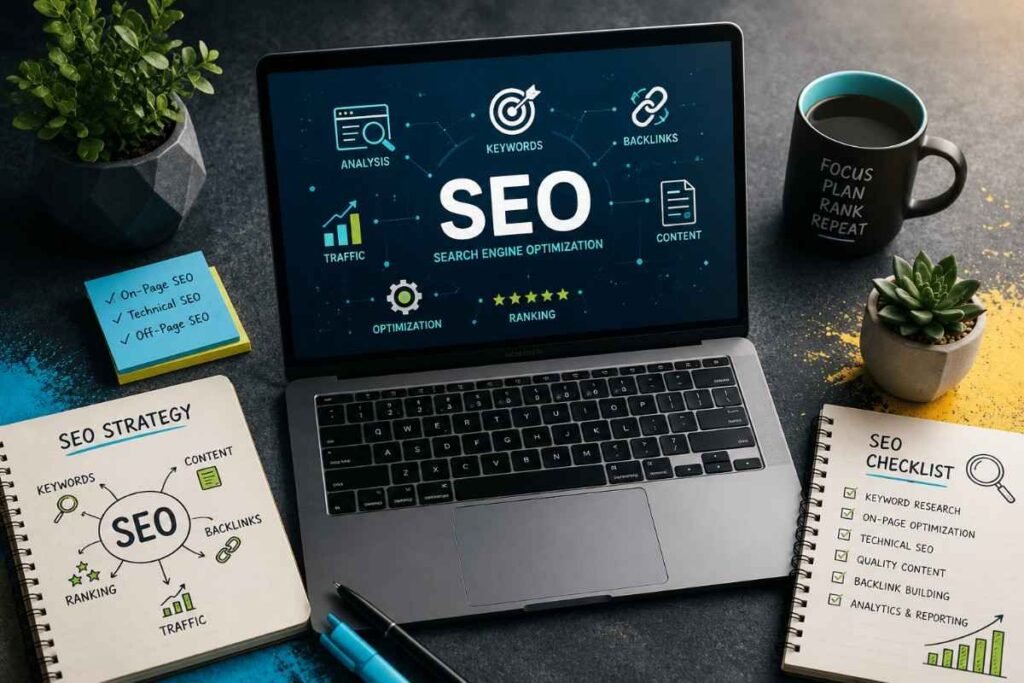
This guide will help you learn the basics of SEO, how search engines work, the different types of SEO, keywords, backlinks, ranking factors, and important practices that can help improve a website’s visibility in search results.
What Is SEO?
SEO stands for ‘Search Engine Optimization’. It is the process of improving a website and its content to increase its visibility in organic search engine results. The main purpose of SEO is to help search engines understand your website while also making the website useful and easy to navigate for visitors.
Why Is SEO Important?
People use search engines every day to research products, compare services, find local businesses, and get answers to their questions. Appearing in relevant search results gives businesses an opportunity to connect with people who already have an interest in what they offer.
SEO is especially valuable because it can create long-term visibility. A well-optimized and genuinely useful webpage may continue attracting organic visitors over time. However, SEO is not an instant process. It requires consistent optimization, quality content, technical improvements, and patience.
Some of the major benefits of SEO include:
- Increased organic website traffic
- Better search engine visibility
- Improved brand credibility
- More relevant website visitors
- Better user experience
- Long-term online growth
- Reduced dependence on paid advertising
How Do Search Engines Work?
To understand SEO, it is important to understand how search engines discover and organise webpages. Although search engine systems are complex, the basic process can be understood through three main stages: crawling, indexing, and ranking.
1. Crawling
Crawling is the process through which search engines discover webpages on the internet. Search engines use automated programs, often called crawlers or bots, to visit webpages and follow links to discover new or updated content. A clear website structure and proper internal linking can make it easier for search engines to discover important pages.
2. Indexing
After discovering a page, a search engine analyses its content and may add information about the page to its search index. The index is essentially a large collection of information about webpages that the search engine has discovered and processed. If a webpage cannot be properly accessed or indexed, it may not be eligible to appear in normal organic search results.
3. Ranking
When someone performs a search, the search engine evaluates relevant pages from its index and decides which results are likely to be most useful for that particular query. Search engines consider many signals when determining results, including relevance, quality, usability, and context.
Search engine optimization focuse on improving these areas so that webpages can provide useful information to users while being easier for search engines to understand.
What Are Keywords in SEO?
Keyword research is the process of finding and analysing relevant search terms. Effective keyword research considers factors such as search intent, relevance, competition, search demand, and the type of content already appearing in search results.
Keywords should always be used naturally within content. Repeating the same keyword unnecessarily, commonly known as keyword stuffing, can reduce content quality and should be avoided.
Major Types of SEO
SEO can be divided into different areas, with each focusing on a specific part of website optimization. The major types include On-Page SEO, Off-Page SEO, Technical SEO, and Local SEO.
1. On-Page SEO
On-page optimization includes creating useful content, using clear headings, optimising title tags and meta descriptions, adding relevant internal links, optimising images, and using keywords naturally throughout the page.
Important On-Page SEO elements inclues;
- Quality content
- Title tags
- Meta descriptions
- H1, H2, and H3 headings
- Relevant keywords
- Internal links
- Image alt text
- SEO-friendly URLs
Good On-Page SEO should improve the page for visitors rather than making the content feel like it was created only for search engines.
2. Off-Page SEO
Off-Page SEO refers to activities and signals outside your own website that can contribute to its online reputation and authority. One of the most commonly discussed parts of Off-Page SEO is backlink building.
Off-Page SEO can include earning quality backlinks, digital PR, brand mentions, content promotion, and relevant online collaborations. Quality is more important than simply collecting a large number of links, and spammy or manipulative link-building practices should be avoided.
3. Technical SEO
Technical SEO focuses on the technical aspects of a website that affect how search engines crawl, understand, and index its pages. It also plays an important role in website usability and overall performance.
Technical SEO can involve improving website speed, mobile usability, crawlability, indexing, HTTPS security, XML sitemaps, structured data, website architecture, and fixing broken links.
4. Local SEO
Local SEO focuses on improving a business’s visibility for location-based searches. It is particularly useful for businesses that serve customers within a specific city, town, or geographical area.
Local SEO is particularly valuable for restaurants, salons, clinics, agencies, wedding planners, retail stores, and other businesses that depend on customers from a particular location.
On-Page SEO vs Off-Page SEO
On-Page SEO and Off-Page SEO are different, but both are important parts of an overall SEO strategy. On-Page SEO focuses on elements that can be directly improved within a website, while Off-Page SEO focuses more on external signals, reputation, and authority.
For example, improving a blog’s title, headings, content, images, and internal links is On-Page SEO. If another relevant website discovers that blog and links to it as a useful resource, that backlink becomes part of Off-Page SEO.
Using both approaches helps create a more complete SEO strategy rather than focusing only on one side of optimization.
What Makes Content SEO-Friendly?
Content should have a clear title, logical headings, readable paragraphs, useful information, relevant internal links, and naturally placed keywords. Images can also be optimized with descriptive file names and appropriate alt text.
The goal should not be to reach a particular word count at any cost. Content should be as detailed as necessary to answer the topic properly without adding unnecessary information.
What Are Title Tags and Meta Descriptions?
A title tag helps describe the main topic of a webpage and can be used by search engines when presenting search results, while a meta description provides a short summary of the page and may appear as part of the search snippet. Both elements are important in Search Engine Optimization because clear and relevant titles and descriptions help search engines understand the page and allow users to quickly identify whether the content matches their search before clicking.
What Are Internal Links?
Internal links are links that connect one page of a website to another page on the same website. They help visitors discover related information and navigate the website more easily.
What Are Backlinks?
Backlinks are links from external websites that point to your website and play an important role in Search Engine Optimization, especially Off-Page SEO. They can help users discover your content and contribute to your website’s authority and credibility. However, not every backlink has the same value; a relevant link from a trustworthy and authoritative website can be more valuable than many unrelated or low-quality links. Instead of focusing only on the number of backlinks, a strong Search Engine Optimization strategy should focus on creating valuable content and building genuine relationships that can naturally generate relevant mentions and quality backlinks.
Website Speed and Mobile SEO
Website speed and mobile usability are essential for creating a smooth user experience and are important aspects of Search Engine Optimization. Slow-loading pages or websites that are difficult to navigate on smartphones can cause visitors to leave quickly. Optimizing images, reducing unnecessary website resources, using responsive design, improving navigation, and regularly monitoring website performance can help improve loading speed and usability across different screen sizes.
Common SEO Mistakes to Avoid
Some SEO practices can negatively affect content quality and overall website performance. Keyword stuffing, copying content, ignoring search intent, creating low-quality backlinks, and expecting immediate rankings are some common mistakes.
Other issues include ignoring mobile usability, publishing thin or unhelpful content, forgetting internal links, using poor website structures, and failing to monitor website performance.
Search engine optimization (SEO) is a long-term process. Focusing on useful content, technical quality, website authority, and a good user experience is generally more sustainable than trying to find quick ranking shortcuts.
Useful SEO Tools
SEO tools can help marketers understand keywords, website performance, search visibility, technical problems, backlinks, and competitor activity. Different tools serve different purposes, so choosing tools should depend on the type of SEO work being performed.
Some commonly used SEO tools include:
- Google Search Console
- Google Analytics
- Google Keyword Planner
- PageSpeed Insights
- Semrush
- Ahrefs
- Screaming Frog
SEO tools provide useful information and data, but understanding what that data means and knowing how to use it to improve a website are equally important.
How to Start Working With SEO
A strong SEO process begins with understanding how search engines work, identifying the right keywords, analyzing search intent, and creating useful content. On-Page SEO, Technical SEO, internal linking, and Off-Page SEO can then be used together to strengthen overall search visibility.
A basic SEO process can include:
- Understand how search engines work
- Perform keyword research
- Analyze search intent
- Optimize On-Page SEO
- Check Technical SEO
- Improve internal linking
- Build website authority
- Create useful SEO content
- Track search performance
- Improve pages based on data
SEO should be treated as an ongoing process rather than a one-time website task. Search behavior, competitors, content, and websites change over time, making regular monitoring and optimization important.
How Long Does SEO Take?
SEO does not normally provide instant results. The time required can vary depending on competition, website history, content quality, technical condition, industry, search demand, website authority, and the amount of consistent optimization being done.
Some changes may produce noticeable improvements relatively quickly, while competitive keywords may require much more time and effort. This is why SEO should generally be approached as a long-term digital marketing strategy rather than a quick solution.
Final Thoughts
Search Engine Optimization is an important part of digital marketing because it helps businesses improve their visibility when people search online. A complete SEO strategy can involve useful content, keyword research, search intent, On-Page SEO, Off-Page SEO, Technical SEO, Local SEO, backlinks, internal linking, and website performance.
Search engine optimization involves many different areas, but they all work toward a common objective: making a website easier to discover, understand, and use. Consistent optimization, quality content, technical improvements, and strong website authority can contribute to sustainable organic search growth.
Most importantly, SEO should not be viewed only as a way to rank higher on search engines. Effective SEO connects relevant searches with useful content while creating a better experience for the people who visit the website.